
The uses and misuses of slot free-play
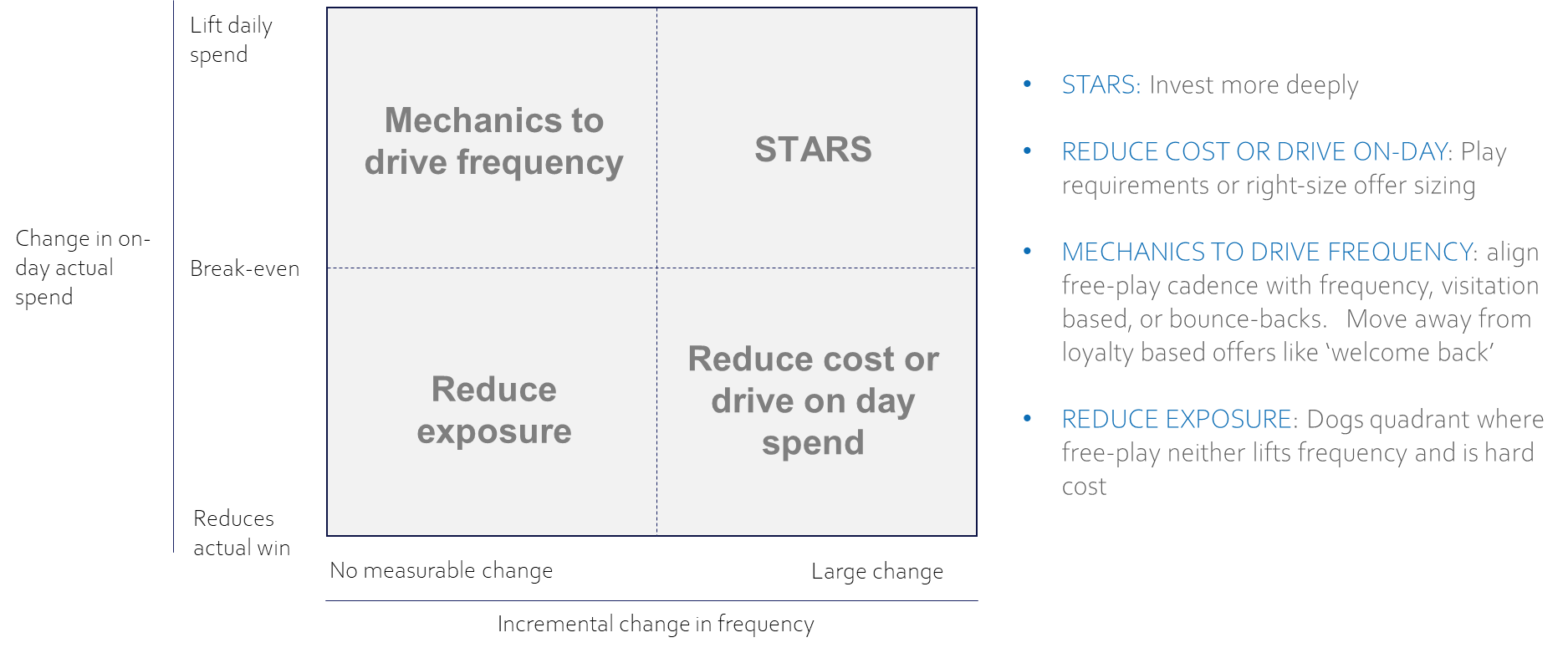
This is a summary, full-content is available to members of the analytical community (Enroll here)
Recent academic scrutiny has illustrated that free-play offers deliver only tepid incremental benefits. Nonetheless, these programs persist and at times expand but rarely contract. Free-play addles crucial metrics such as slot hold, coin-in, and occasionally a player’s bankroll, thus obscuring results making analysis a nearly intractable challenge.
TLDR
We found that the avg program has an effective cost of ~30% and rarely recoups the face-value of the free-play coupon but we did find statistical evidence that free-play increases frequency (a 10% increase in free-play drives a 4%+ increase in frequency)
Understanding free-play ROI, requires an understanding of the mechanics of free-play. Lets start with an example of a player who buys-in for $100. When she begins to play, she starts with $100 on the meter. Assuming her average wager is $2, she will make 50 spins/bets to complete the first cycle of her buy-in. At the end of cycle one, coin-in will be $100, and if she is average, she will have lost approximately $8, beginning cycle two with $92 on the meter. This process typically repeats until she:
Exhausts her bankroll,
Hits a win objective, or
Hits a loss budget, or
Loses interest, or
Runs out of time.
For reference, typically, coin-in hold is around 8%, but win hold on slot drop is 30% to 45%, implying the average patron cycles her initial buy-in around six times (30-45% ÷ 8% = ~6x). From a player’s perspective, coin-in is an output, and free-play distorts how players arrive at the objectives outlined above.
The first part of the slot free-play enigma is on-day spend, which determines the effective cost. Successful programs, in our assessment, are those that have finely tuned their free-play initiatives to recoup the coupon's face value while driving incremental frequency. We estimate that most properties have managed this feat. Data from four casinos we reviewed which included, over 4m play-days, Free-play has effective cost of free play is 20% to 40%, though results vary.
The second part of free-play ROI is frequency. Here free-play shines. We found that on average, a 10% increase in free-play issuance generally results in a 4 to 7% rise in frequency. These outcomes vary (sometimes sharply) along lines of player value and competitive landscape. To boost the return on investment from free-play, we recommend a shift towards a more personalized approach, necessitating the adoption of AI to achieve at scale.
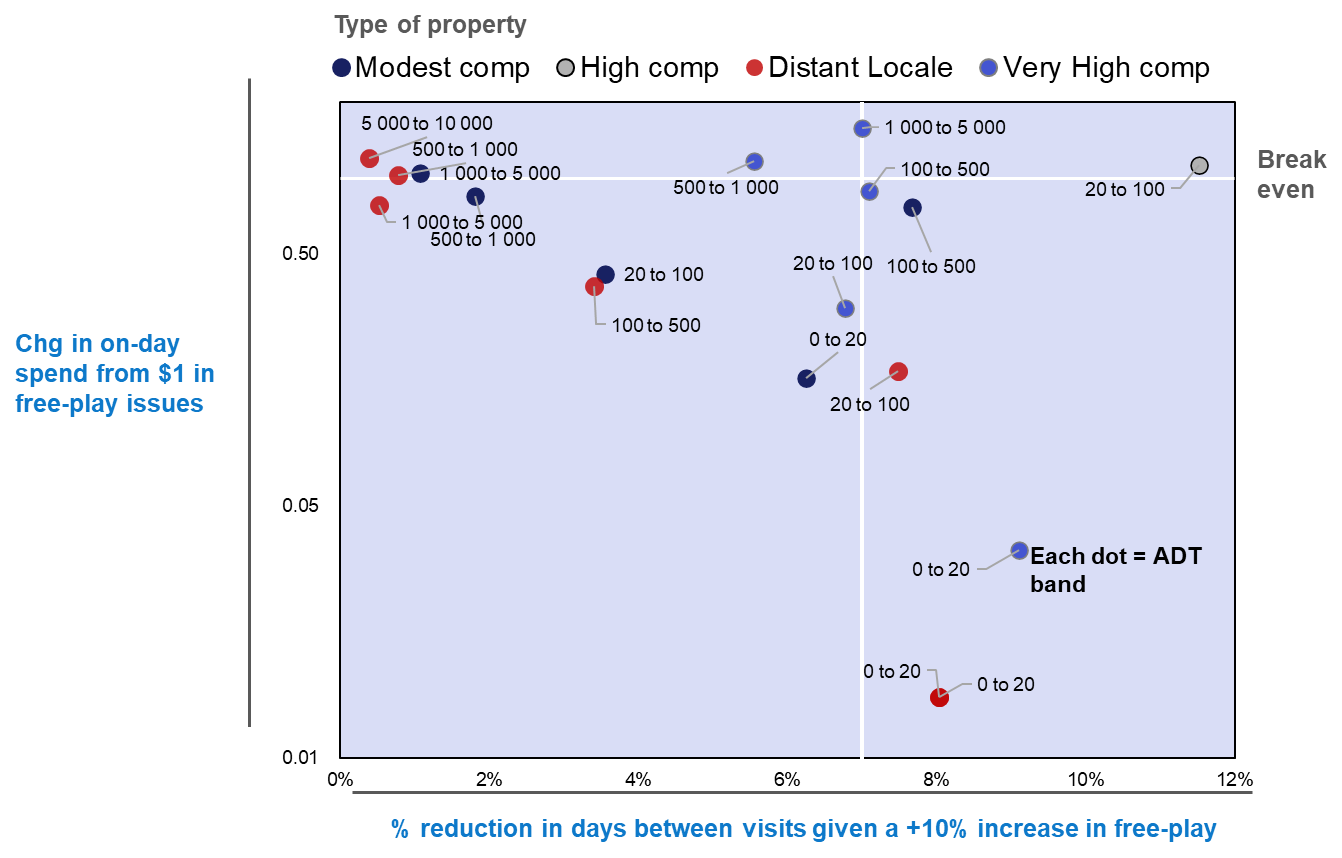
Effective cost and impact on free play.
What's wilder is how predictable all of this actually is. By factoring in trends on the table, cultural background, and a few basic player features, Differential's models can predict an existing player's next bet with roughly 85% accuracy — and even a brand-new player's bet lands in the 70–80% range.
Betting choices stay remarkably stable, but wager size is where things get interesting. Players who are losing tend to chase risk and bump up their bets, while players who are winning get cautious — locking in gains rather than pressing their luck. Classic prospect theory, playing out in real time across millions of hands.
